
My grandmother's legacy
When my grandmother set out dishes on the big family table in Cairo, she didn't worry about calories, macronutrient ratios or glycemic indices. These concepts were completely foreign to him. However, she had an infused knowledge of nutrition, passed down from generation to generation. She instinctively knew what nourished the body and what gladdened the soul. His guide was not an Excel table, but common sense and the observation of his people.
She knew that fresh herbs brought vitality, olive oil gave strength and grilled meat built the body. She calculated nothing, she balanced everything with diversity and freshness. This intuitive approach worked perfectly. No one was overweight, no one suffered from chronic fatigue. Health was the natural consequence of a way of living and eating that respected the cycles of life. We have much to relearn from this simplicity.
The table as regulator
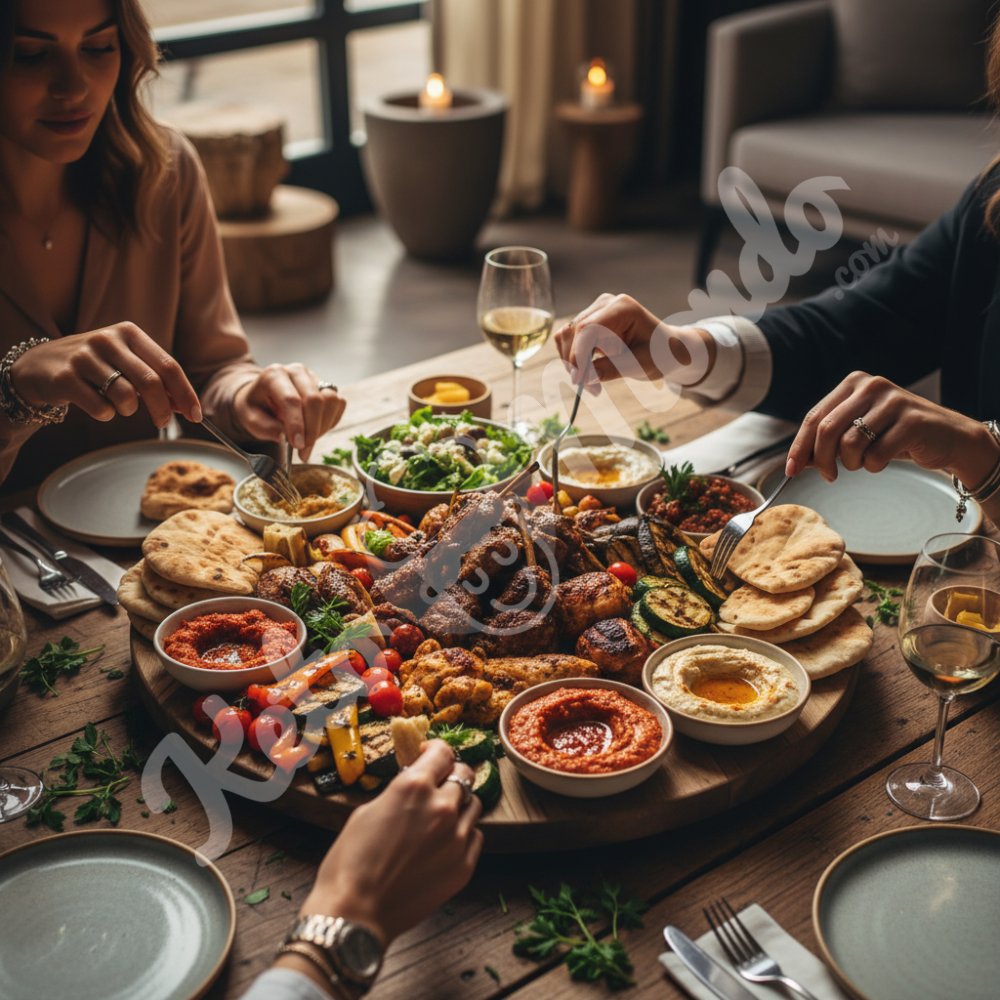
In Levantine culture, the meal is a collective act. Everyone has access to the same dishes arranged in the center of the table. This shared access creates a natural balance. We cannot isolate ourselves with a disproportionate portion without it being noticed. We eat what comes to us, we taste everything, we respect the portion of others. The collective table acts as a social and biological regulator. It prevents individual excesses and promotes moderation.
This balance does not come from a constraint, but from a harmony. When you share a mezze platter rich in vegetables, herbs and good fats, satiety arrives for everyone at the same time. We stop eating because the conversation is rich, because we feel fulfilled, because the moment is full. The tradition has already integrated the principles of metabolic health into its sharing rituals. Just follow them to find balance.
Peace after the meal
Satisfaction was never a conscious goal in my childhood cooking. It was simply the inevitable result of a well-made meal. We were not looking to be 'full' in the mechanical sense of the term, we were looking to be at peace. And this peace always came. After eating raw food, cooked with love and shared with joy, we felt complete. There was no room for frustration or the urge to snack.
This lasting satisfaction is the key to long-term health. It frees us from food obsession. When we are truly nourished — physically by nutrients and emotionally by sharing — we can move on. You can devote yourself to your work, to your family, to your passions. Food returns to its rightful place: a solid foundation for a fulfilling life, not a source of permanent anxiety.
A morality of the plate
Sharing creates its own morality, an ethic of consumption. At a Levantine table, we learn very early not to be greedy, to leave the best pieces for the guests or for the elders. This awareness of the other tempers our own impulses. We learn to savor what we have, rather than desire what we don't have. It’s a life lesson that directly applies to our metabolic health.
This mutual awareness creates a natural balance that no solitary regime can match. We eat better because we eat together. We respect our body because we respect the table. By giving sharing its central place again, we find a form of wisdom that protects us against the excesses of modern consumption. Honesty at the table is the first step towards honesty with yourself.
The intelligence of tradition
Today, when I cook, I don't feel like someone on a low-carb or keto diet. I just feel like someone who follows what they know is right. It’s the same intelligence that worked in my grandmother’s hands that guides mine. Balance does not come from calculations, it comes from respect for life, the earth and others.
I invite you to rediscover the power of sharing. Don't eat alone in front of a screen. Invite friends, place simple, real dishes in the center of the table, and let the magic happen. You will see that your health will improve on its own, without effort and without frustration. Tradition already contained all the answers; it is simply up to us to put them into practice with love and gratitude. Enjoy your meal, in the peace of sharing.