
Fire in the mountains
I was born in the Andes, at an altitude where oxygen is rare, where each breath is a negotiation with the sky and where fire is not a decorative luxury, but a vital, almost sacred resource. I grew up in the shadows of the peaks, where the cold of the night descends like a coat of lead as soon as the sun dips behind the ridges. In my memory, the smell of my childhood is not that of flowers, but of crackling quebracho wood and blue smoke rising toward the stars. I watched my father and grandmother tame this flame: they did not cook to follow a trend or for the aesthetics of a magazine, but out of a necessity dictated by the earth itself. With fire, you don't cheat. We cook what can withstand its bite, what comes out grown, transformed, magnified. The dense proteins, the fats which melt and nourish the embers, the root vegetables which resist the intense heat, the wild herbs which bring a sharp freshness to the middle of the furnace. It was there, in front of this hearth, that I understood for the first time that these foods — and they alone — create a satiety that is not a simple heaviness in the stomach, but an inner strength, an energy that seems to emanate from the bones themselves.
In these heights, we quickly learn that what we cannot throw directly onto the grill or into the ashes often has no place at the table. Cereals, flours, refined sugars – these inventions of the plain – are absent from our ancestral culinary horizon. This is not an ideological restriction or a fad diet; it is a logical consequence of living at altitude and cooking over a fire. Fire rejects the illusion of starch. It requires substance, resistance. When you place a piece of meat on the coals, you don't need binder, breadcrumbs or sugar to create a crust. The Maillard reaction, this kiss of fire on the protein, creates a complexity of flavors that no factory will ever be able to reproduce. It's a lesson in applied biology: the body recognizes this thermal and chemical signature as a signal of dense nutrition, of energy that will last, of fuel that won't betray you when the trail gets steep.
Natural simplification
With fire, there is no room for superficial complexity, for those artifices which mask the poverty of a mediocre ingredient. In modern cooking, we often use sugar and starch as crutches, dressings to give volume to what has no taste or to bind what has no structure. Fire is a merciless revealer. He exposes the true nature of what you entrust to him. No syrupy sauces to hide poor quality meat. No layers of flour to create false satiety. Just the protein and the vegetable, naked before the heat, revealing their deeper truth. And when we eat like this, we rediscover a satisfaction that the complicated dishes of the city have forgotten. It is a satisfaction that does not come from the volume ingested, but from the nutritional density and sensory purity.
I often observe the faces of those who taste this fiery cuisine for the first time, stripped of superfluous carbohydrates. At first there is a surprise, almost a distrust: how can such a simple dish be so complete? Then comes calm. Grilled meat, with its crispy fat and juicy center, sends an immediate message to the brain: 'You are nourished.' Roasted vegetables, whose natural sugars have been concentrated by heat without being diluted by water, provide a texture and depth that are sufficient in themselves. The absence of fast carbohydrates is not experienced as a lack, but as a liberation. We don't finish the meal wanting more or looking for something sweet to compensate for frustration. We finish the meal with the feeling of being grounded, solid, ready for the rest of the day.
Altitude and energy requirement
At two thousand meters altitude, or even higher in the folds of the cordillera, the body does not forgive fuel errors. Oxygen is rare, the metabolism is constantly called upon to maintain internal temperature and ensure physical effort. In this environment, fast sugars and insulin spikes are more than inconveniences; they are dangers. An energy 'crash' in the middle of a climb or during a day of work in the fields is not an option. We need energy that burns like a big log of hardwood, slowly, surely, for hours, and not like a handful of straw that catches fire and goes out in an instant. This is the very definition of the metabolic state that we seek today with low-carb and keto, but for us, it was simply the condition for survival.
Fire and the cooking it requires — those grilled proteins, those respected animal fats, those fibrous vegetables — provide exactly that long-lasting fuel. By accustoming the body to drawing its energy from fats and proteins, we develop metabolic endurance which is the mirror of the physical endurance of mountain people. Blood sugar remains stable, the mind remains clear, and hunger never becomes a panicked emergency. It's a lesson that the modern West, with its obsession with cheap, processed carbs, has tragically forgotten. We have exchanged the stability of fire for the instability of steam, and our health is paying the price. Returning to direct cooking also means returning to a more sober, more robust, more human physiology.
Real flavor
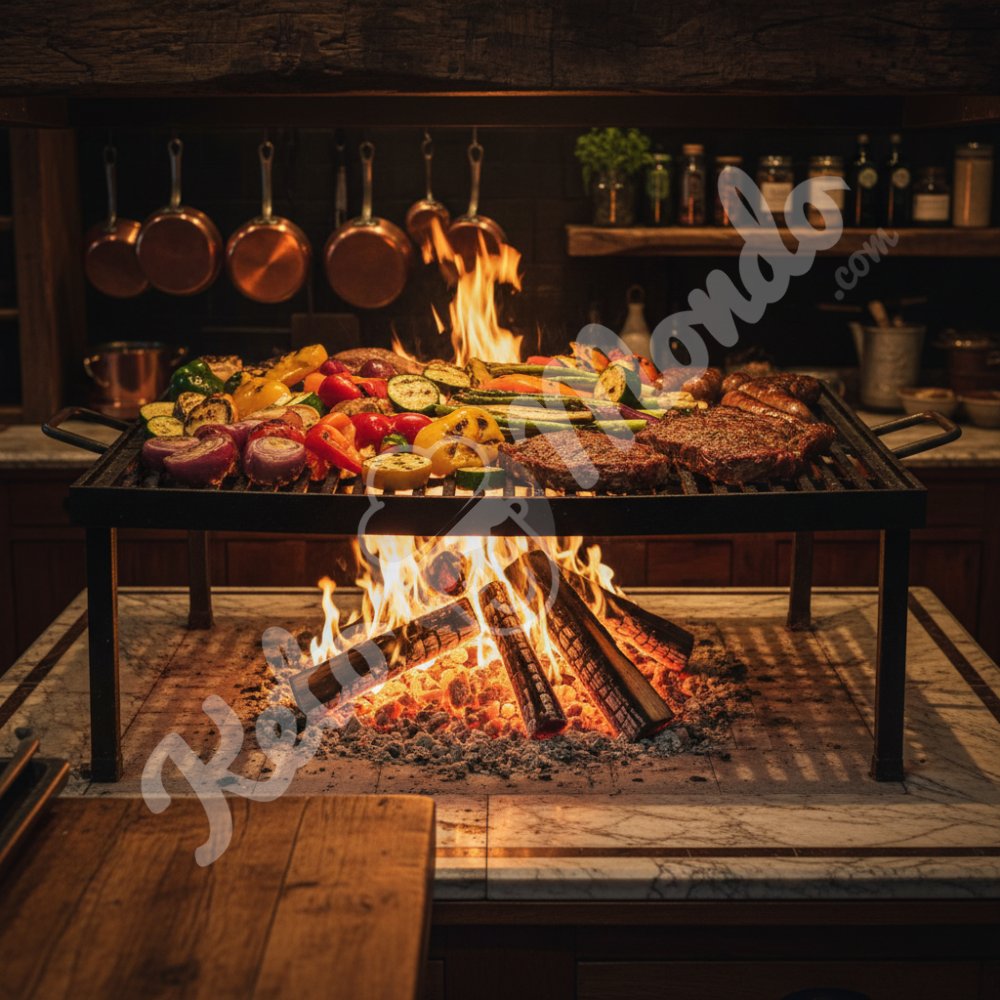
When a piece of beef or lamb is grilled over a wood fire, when the vegetables are thrown on the hot plate with only a little salt and a few fresh herbs, the flavor that emerges is the original flavor. It is not improved by additives, it is not transformed by industrial processes; it is simply revealed by heat. The fat, as it melts, becomes the vector of all the aromas of wood and earth. The salt is not there to mask, but to highlight. It's a total sensory experience that nourishes the palate in a way that artificial flavors can never match. In a low-carbohydrate diet, this sensory satisfaction is crucial. If you take away sugar, you have to give the body a bigger, deeper reward.
Fire allows this transition effortlessly. He transforms simple, almost raw ingredients into something extraordinary. A zucchini is no longer just a watery vegetable; it becomes a piece de resistance with its grill marks and its nutty taste. Meat is no longer just a source of protein; it becomes an aromatic journey. This richness of taste is what makes the low-carb lifestyle sustainable. We don't eat 'less', we eat 'better', with an intensity that cooking with water or in the microwave can never achieve. It's the secret of the ancients: restriction doesn't exist when the quality of the experience is at its peak.
Fire transmission
I am not here to give you precise recipes or cold technical instructions. I am here to share an approach, a philosophy of life. Fire is humanity's oldest tool, the one that shaped our brain, our digestive system and our culture. Learning to cook with him means reconnecting with an uninterrupted line of know-how. It’s understanding that fire never lies. If your ingredient is bad, the fire will show it. If your action is impatient, the fire will punish you. But if you respect the product and the time, the fire will offer you the best of the earth.
Ultimately, adopting a low-carb diet and rediscovering cooking with fire are two sides of the same coin. It is a return to basics, a refusal of modern illusions and a celebration of what truly nourishes us. When we accept that proteins, good fats and seasonal vegetables are sufficient, that starch is just unnecessary background noise, we enter a new dimension of health and pleasure. Fire teaches us patience, quality and truth. And it is this truth, burning and sincere, that I hope to see shine in your kitchens, so that each meal is a reconnection with your own nature.