
Greenery as a structuring element
In modern Western kitchens, I've often noticed that fresh herbs are treated as mere decoration, a pop of color hastily thrown over the edge of a plate to make it more presentable. They are called 'toppings', a word which suggests that they are optional, secondary. But in the Andes, where I learned to read the landscape through flavors, herbs are never an accessory. They are the beating heart of the meal, the structural element that gives meaning to the protein and the fire. A green sauce — whether it's based on cilantro, flat-leaf parsley, fresh oregano or huacatay — isn't there to look pretty. It is there to bring a dimension of life, a vegetal vibration which balances the density of the grilled meat. It is an architecture of taste where green is not a complement, but a foundation.
What fascinates me most is the ability of these herbs to replace what the modern world desperately seeks in sugar: intensity and contrast. Sugar creates immediate but superficial satisfaction, a peak that quickly subsides. Herbs awaken the palate with their liveliness, their subtle bitterness and their sharp freshness. They create a satisfaction that lasts, a feeling of cleanliness in the mouth which allows you to savor each bite of fat and muscle without ever saturating. For us who have chosen to leave aside fast carbohydrates, these green sauces are our best allies. They remind us that richness comes not from syrupy sweetness, but from aromatic complexity. They transform a simple piece of meat into a total sensory experience, without ever disturbing our metabolic balance.
Aromatic complexity
A well-executed green sauce is a layered symphony. First there is the attack, carried by the acidity of lime or an artisanal cider vinegar, which makes you salivate and prepares the ground. Then comes the body, the texture of the herbs chopped with a knife – never mixed into a shapeless mush – which release their essential oils under the bite. There's the heat of fresh chili, which warms without burning, and the earthy sweetness of green onion or spring garlic. Each ingredient plays its part, creating a flavor that is never flat, never monotonous. It is this depth that tricks the brain and offers it the reward it expects from a hearty meal. When the palate is thus solicited by a multitude of aromatic signals, the need for 'volume' or 'filling' with starch naturally disappears.
This is a crucial point in the low-carb diet: we are not looking to eat less flavor, we are looking to eat more, but the real thing. Andean green sauces are the antithesis of industrial sauces loaded with corn syrup and thickeners. They are alive, unstable, vibrant. They change according to the season, depending on the freshness of the bouquet of herbs you hold in your hands. This variability is a wealth. It forces us to be present, to taste, to adjust. It reconnects us to the act of nourishing, far from the standardized flavors that anesthetize our senses. By choosing green over sugar, we choose clarity and truth of taste.
Freshness and digestion
Beyond the immediate pleasure, there is an ancestral wisdom in the massive use of fresh herbs: their role in digestion. In the mountains, where we consume rich meats and animal fats to support the effort, herbs are the guardians of our intestinal comfort. Cilantro, for example, has been known for millennia for its carminative properties and its ability to help the body process heavy metals. Parsley is a mine of vitamin C and iron, but it is also a powerful natural diuretic. By pairing these herbs with our proteins, we're not just eating, we're healing ourselves. We create an internal environment favorable to the absorption of nutrients, without the heaviness caused by starchy foods.
When you eat grilled meat with a generous helping of green sauce, you notice that the feeling after the meal is radically different. There is no drowsiness, no feeling of 'brick' in the stomach. The energy remains available and fluid. This is because herbs stimulate the production of digestive enzymes and bile, making it easier to break down fats. It is perfect harmony: taste calls for health, and health reinforces taste. It's an equation that the people of the Andes solved a long time ago, and that we are rediscovering today through the prism of modern nutrition. Greenery is the lubricant of our metabolism.
Availability of raw
Another reason for the centrality of green sauces is their simplicity of preparation. At altitude, where firewood is precious and cooking time is lengthened by atmospheric pressure, raw is a blessing. Being able to whip up an explosive sauce in just a few minutes, with just a knife and a bowl, is a time-honored form of efficiency. This teaches us that haute cuisine does not need complicated techniques or expensive equipment. She needs good products and a fair action. This accessibility is fundamental to maintaining a low-carb lifestyle in the long term. If it's too complicated, you end up giving up. But chopping a few herbs and drizzling them with good olive and lemon oil is within everyone's reach, every day.
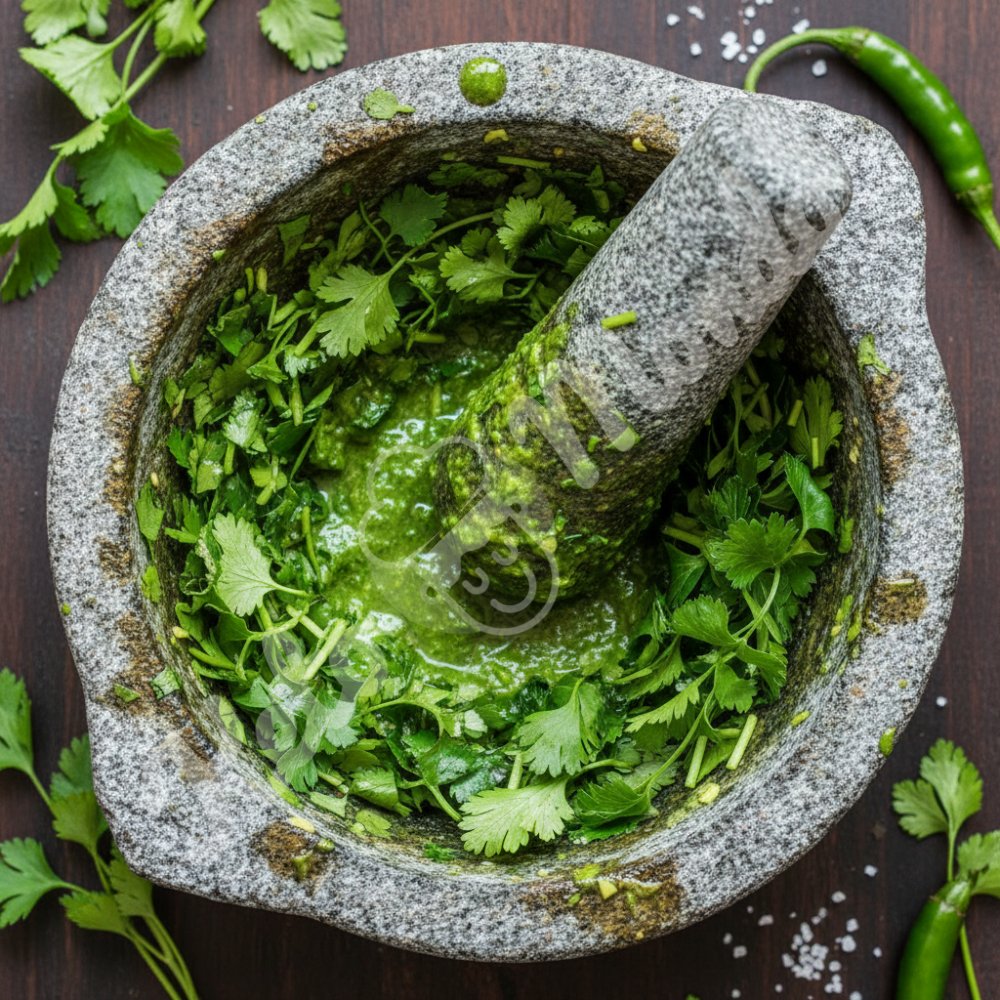
In my kitchen, the mortar and pestle are my favorite tools. They allow the fibers to be crushed without tearing them, and to combine flavors without oxidizing them. It is a meditative gesture, a way of mentally preparing yourself to receive the food. The result is a sauce that has texture, chewiness and personality. It is the opposite of the 'ready to eat' food that surrounds us. It's a food that requires a minimum of commitment, and which returns it a hundredfold in terms of vitality and pleasure.
Dosage and intuition
Making a green sauce is an exercise in intuition. There is no set recipe, as each herb bouquet is different. One day the cilantro will be very strong, another day it will be milder. Your lemons can be more or less acidic, your peppers more or less fiery. That's where the magic is: you have to taste. You need to trust your senses rather than a scale. It is a school of presence. By adjusting the salt, acid and heat, you learn to know your own needs, to listen to what your body is calling for in that moment. Sometimes you'll need more acidity to cut through generous fat; Sometimes you'll want more greens to satisfy a nervous hunger.
Ultimately, these green sauces are much more than a condiment. They are a philosophy of life. They teach us that satisfaction is not found in the accumulation of empty calories, but in the intensity of the moment and the quality of the ingredients. They show us that we can live without sugar, not in deprivation, but in an explosion of fresh and authentic flavors. Each time you prepare a green sauce, you honor an age-old tradition that places the plant in the service of man, and you offer your body the respect it deserves. It is a simple, profound, and infinitely renewable joy.