
Spices as a mother tongue
In my childhood home in Lahore, mornings began not with the sound of an alarm clock, but with the rhythmic chant of the mortar and pestle. My mother, leaning over her work surface, prepared the basic mixture for the day. For her, and for all the women of my lineage, spices were not condiments added at the end to 'spice up' a dish. They were the foundation, the very backbone of everything we ate. I learned to read the world through the vapors of turmeric, coriander and cardamom. It wasn't just cooking, it was a native language, a way of communicating love, protection and health without ever uttering a word. Each seed, each bark had a precise function, a place in an invisible architecture that supported our vitality.
This approach taught me that spices structure the meal much more than starches or sugars do. In many modern cultures, rice or bread is used as a neutral carrier for flavor. But in my vision, inherited from this Pakistani wisdom, it is the spices that create the sensory volume. They occupy the space of the palate, they stimulate the receptors so completely that the need for carbohydrate support naturally disappears. When a sauce is built on a foundation of healthy fats and a full spectrum of aromatics, it has a density that stands on its own. We don't eat to fill our stomach with empty volume, we eat to absorb a complexity that nourishes every cell.
Layered Flavor
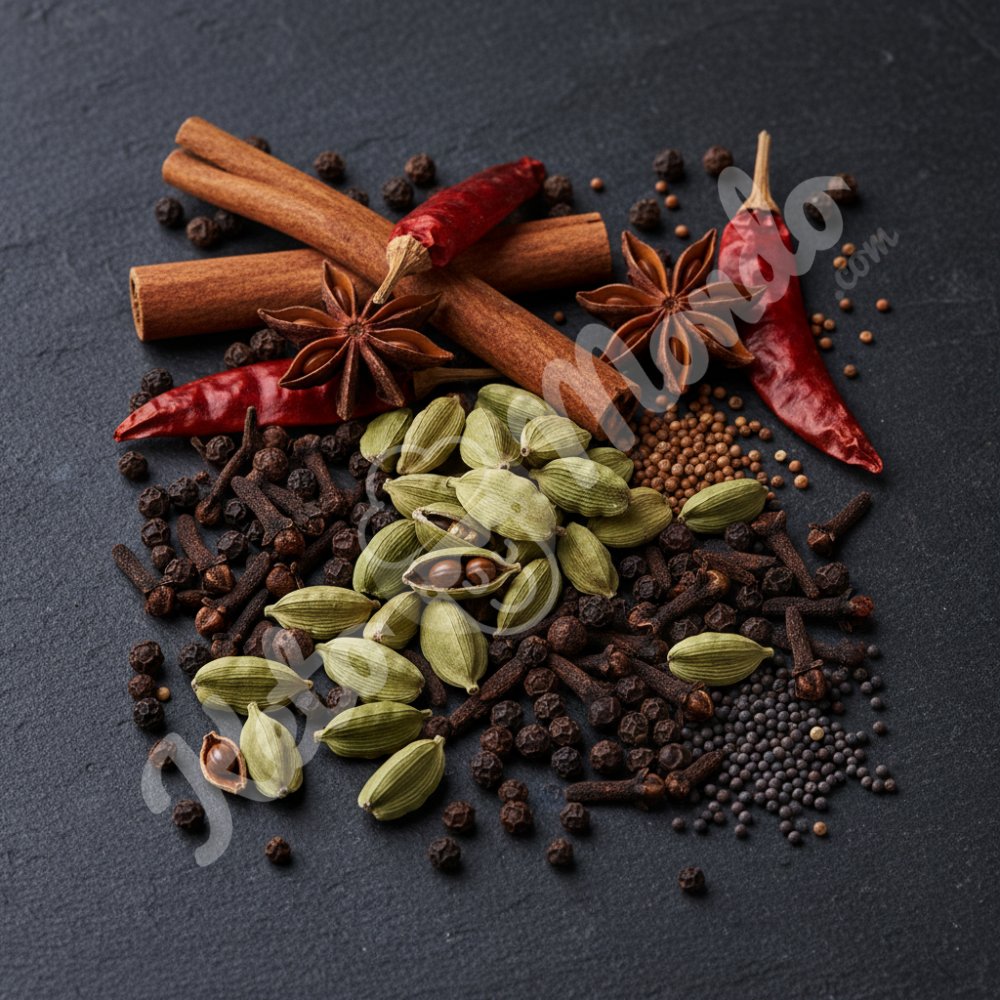
A successful dish is a temporal symphony. First there is the attack, that first encounter with the top notes — perhaps the freshness of a crushed coriander seed or the immediate spiciness of a green chili pepper. Then comes the heart of the dish, where earthier spices like cumin and turmeric unfold, creating a feeling of solidity. Finally, there is persistence, that gentle warmth of cinnamon or black cardamom that lingers in the mouth long after the last bite. This layered structure is what creates true satiety. The brain receives a multitude of sensory signals that tell it that the meal is rich, complex and complete. It's a form of satisfaction that sugar, with its unique and brutal peak, is incapable of offering.
By eliminating fast carbohydrates, we finally give room for this complexity to express itself. Sugar tends to mask nuances; it flattens the relief of the spices. Without it, the palate becomes more sensitive, more capable of distinguishing the subtlety of a clove or the slight bitterness of fenugreek. This newfound sensitivity is the key to a sustainable low-carb diet. We do not feel deprived, on the contrary we feel awakened to a world of flavors that we were previously unaware of. Each meal becomes an exploration, a dialogue between the ingredients and our own senses, where satiety is not a heaviness in the stomach, but a calming of the mind.
Spices and metabolism
Beyond taste, spices are powerful metabolic agents. In my tradition, we never separate cooking from pharmacopoeia. Turmeric is used for its anti-inflammatory properties, ginger to stimulate the digestive fire, and fennel seeds to soothe the system after a meal. When we cook with such a variety of spices, we send specific instructions to our body. We help it break down fats, stabilize blood sugar levels and optimize nutrient absorption. It’s a form of ancestral bio-hacking. Spices act as catalysts, transforming a simple meal into a tool for internal regulation.
This functional dimension is crucial in a ketogenic or low-carb approach. Often people worry that eating more fats will be 'heavy' on the system. But this is where the spices come in: they provide the necessary lightness through their enzymatic action. They allow the body to process dense nutrients with remarkable efficiency. By integrating this age-old knowledge into our modern daily lives, we are rediscovering that health does not come through restriction, but through intelligent seasoning. A cuisine rich in spices is a cuisine that works for us, which supports our metabolism instead of overloading it.
Heat rather than sugar
There is frequent confusion between the need for sugar and the need for sensory comfort. Sugar brings immediate but fleeting satisfaction, often followed by emptiness. Spices, on the other hand, provide heat. It is a deep sensation, which starts from the center of the body and spreads towards the extremities. This warmth is incredibly reassuring. When I prepare a curry rich in hot spices like black pepper, nutmeg or mace, I create an internal environment that no longer needs the crutch of sugar. The stimulation is so intense and gratifying that the desire for softness disappears by itself.
This is one of the most valuable secrets I share: if you have a sweet tooth, look for aromatic depth. Replace the linearity of glucose with the multidimensionality of spices. Learn to appreciate the natural 'sweetness' of quality cinnamon or the roundness of green cardamom. These flavors don't cause an insulin spike, but they satisfy the same pleasure zone in the brain. It is a transition from dependence to appreciation, from reaction to conscious tasting. By changing our source of pleasure, we change our metabolic destiny.
The art of intuitive dosing
I am often asked for the exact measurements of my spice blends. My answer is always the same: listen to the dish. Dosage is not an exact science, it is a relationship. Each batch of spices has a different potency, each base ingredient reacts differently. Cooking with spices requires being present, here and now. You have to smell, taste, adjust. It is a form of active meditation that reconnects us to the act of nurturing. When we pour the spices into the hot oil – what we call 'tarka' – and the aromas are suddenly released, it is a moment of pure presence.
This art of dosage is what transforms a cook into a healer. It is the ability to feel what the body needs that day: more warmth, more freshness, more earth. By regaining possession of this ancestral tool, we regain control over our health. We are no longer passive consumers of processed products, but artisans of our own well-being. Spices are our most faithful allies in this journey towards a more sober, more intense and infinitely more tasty life. They are proof that you can have it all: immense pleasure, deep tradition and radiant health.